
Gazelle T4 Tent Review: Car Camping Pros, Cons, and Our Experience
The standard Gazelle T4 hub tent is my pick for car campers and beginners who want a walk-in shelter standing in about 90 seconds. It’s the wrong pick if you’re carrying your gear more than a few steps from the vehicle. That’s the short version of what I learned after camping in ours often, before we switched to truck campers.
The T4 is a four-person instant tent built around a pre-attached hub system. There are no poles to thread, no color-coded sleeves, and no instruction sheet to squint at in the dark.
You pull four webbing loops, push up the roof hub, and get a 94-by-94-inch ground tent with roughly 61 square feet of floor space and a 78-inch peak. I’ve set it up in fading light after a long drive and had a place to stand before the headlamps came out.
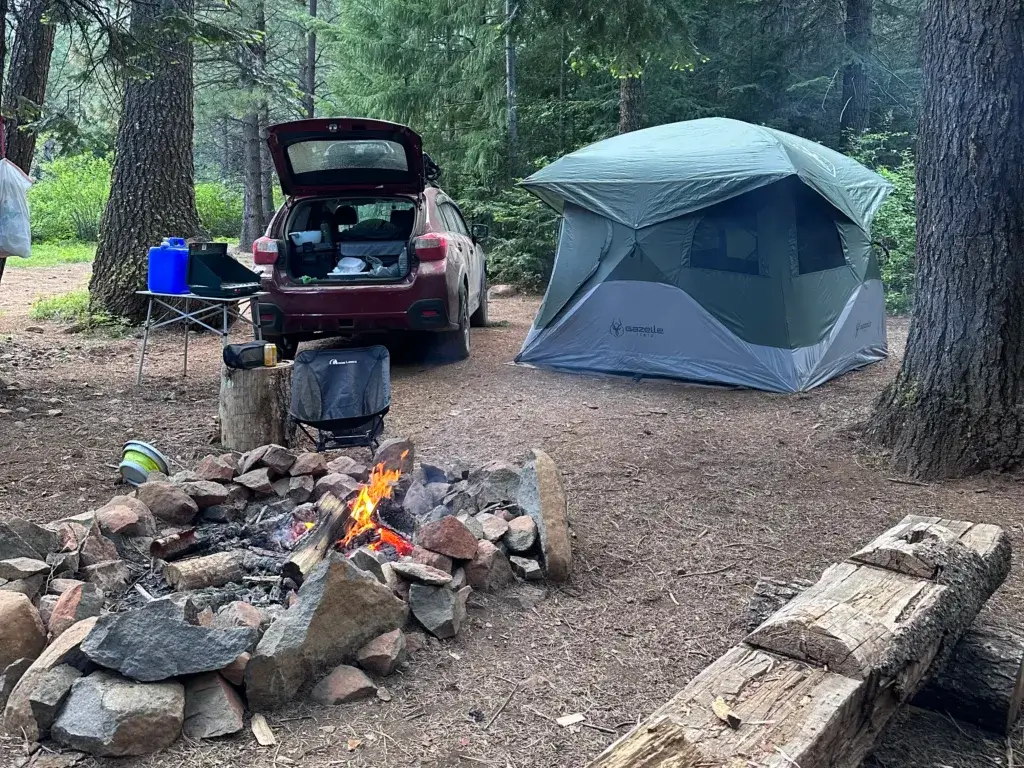
What the T4 asks for in return is space in your vehicle and some honesty about the weather you camp in. The packed bag is bulky, the tent weighs around 34 pounds, and the tall, boxy shape catches wind in a way low-dome tents don’t.
One evening, a wall caved in on us during a gust. That taught me more about staking this tent than any spec sheet could. Ahead, I’ll walk through whether the T4’s fast setup and standing room fit the way you camp, or whether your money belongs in a different shelter. If you want more of my notes on gear that has traveled with us, the rest of our car camping posts are a good place to wander next.

Easy 90 Second Set-Up, Waterproof, UV Resistant, Removable Floor, Ample Storage Options, 4-Person, Alpine Green, 78" x 94" x 94"
Standing room and freedom of movement, plus plenty of windows for enjoying the view.
Setup and Pack-Down in Real Camping Use
Setup is the T4’s headline feature, and it holds up. Pulling the four hub walls open and popping the roof takes under two minutes with two people, even with the rain fly on. Packing it back into the bag is the slower half of the job, and that gap surprises most first-time owners.
How the Hub System Sets Up
The tent comes out of the duffel as one piece. The fiberglass frame is already sewn into the body, so the “assembly” is mechanical rather than manual.
Lay the tent flat with the black floor facing down. Grab the webbing loop sewn into the center of each wall and pull outward until the wall snaps into position. Repeat on all four sides.
The last wall is stiffer than the first three. Fabric tension builds as each side locks, so the fourth one needs a real tug. Wrapping a bandana or glove around the webbing loop saves your palm.
Once all four walls are out, step inside and push up on the roof hub until it clicks. That’s the whole tent.
If you plan to use the rain fly, leave the roof collapsed until the fly poles are seated. Otherwise, you’ll fight tension that doesn’t need to exist.
What Solo Setup Feels Like
One person can set up the T4 without help. The walls pop one at a time, so there’s nothing to hold in place while you run to the other corner. That’s where solo pitching normally falls apart on a big tent.
Solo setup takes longer than the marketing 90-second figure because you’re walking the perimeter instead of splitting the work. Budget three to five minutes for the body, fly, and stakes on your first few outings.
The fly is where a second set of hands earns its keep. Spreading it over an eight-foot-tall box in a breeze is awkward alone, though hooking one center clip first keeps it from sliding off while you walk around.
Why Folding It Back Into the Bag Takes Longer
Pack-down runs three to four minutes, roughly triple the setup time. Nothing about it is hard, but the order matters.
Drop the roof hub first, then push each wall inward at the center, collapsing the tent back toward a flat square. Fold it in on itself, roll it from one edge, and strap it before it can spring open.
The duffel is generous, which helps. Stakes, guy lines, and the fly all fit alongside the tent body without a wrestling match.
People usually get frustrated when they try to fold the tent while it’s still damp and stiff. Shake off the dew, wipe the floor, and the roll goes smoothly.
Stakes and Guy Lines for a Secure Pitch
The T4 has eight base stake loops: four at the corners and four between them. Use all eight. The loops are large grommets sized for the V-stakes included with the tent, and skipping half of them is the main reason this tent behaves badly in the wind.
Four guy lines and four extra stakes come in the bag. With the fly on, attach the lines to the grommets on the fly. Without the fly, run them from the hub loops at the center of each wall.
Angle the lines out at roughly 45 degrees and get the stakes deep. On soft sand or pine duff, swap in longer stakes from your own camping gear kit. The stock V-stakes pull out of loose ground under load.
Interior Comfort for Car Campers and Dogs
Inside, the T4 gives you 61 square feet of floor space with near-vertical walls and a 78-inch peak. Two adults and two large dogs fit without anyone crawling over gear.
The usable room feels bigger than the number suggests because the walls don’t slope inward the way a dome tent’s do.
How Much Livable Space Does the T4 Provide?
The footprint is 94 by 94 inches, a square that works out to about 61 square feet. Gazelle rates it as a 4-person tent, and four sleeping pads do fit edge to edge on the floor.
Four adults plus luggage is tight. Two people with cots, a cooler, and a dog crate is comfortable.
That’s the split most owners land on: a four-person rating that camps best as a roomy two-person shelter with space for pets and bins.
Because the walls rise almost straight up, floor space translates into livable space. In a cabin tent shape, you can put a duffel against the wall and still sit next to it. In a sloped dome, that same duffel eats knee room.
Standing Height and Vertical Walls
The 78-inch center height lets most adults stand up straight. Changing clothes without a yoga routine is the practical benefit. On rainy mornings, it’s the difference between waiting out a shower and being miserable.
The vertical walls matter for taller campers near the edges too. Headroom stays close to full height until you’re within a foot of the wall, so a cot pushed against the side still lets you sit upright.
Door, Window, and Storage Layout
The T4 has two large D-shaped doors on opposite sides. Two exits mean nobody climbs over a sleeping partner at 2 a.m. With both unzipped, you get a clean cross-breeze through the tent.
Six mesh windows wrap the structure, including panels on every side and mesh at the roof. Ventilation is the T4’s strong suit in warm weather, and the view from inside is part of why it feels roomy.
Every mesh panel has a zip-up fabric cover for privacy and warmth. Interior storage includes pockets on the walls and a gear loft area up top for headlamps, phones, and small items.
It’s enough for essentials, though I still used a small bin for anything bulkier than a paperback. Our full tent camping hacks post covers how we organized ours.
Sleeping Pads, Cots, and Dog Beds Inside
Two standard cots fit side by side with an aisle between them, which is the setup I recommend for the T4. Cots take advantage of the vertical walls and keep your bedding off a floor that dogs will track dirt onto.
Sleeping pads work fine too, and four regular-width pads cover the floor. With pads, add a layer underneath. Tent floor insulation makes a real difference on cold ground because the T4’s floor is thin.
Our two 70-pound German Shepherds slept in the T4 with us regularly. There is room for two large dog beds along one wall without crowding the door zone.
We use a Helinox Elevated Dog Cot for them, which keeps their hair off the floor and gives them a defined spot. If you’re new to bringing pets along, our notes on camping with large dogs and the gear in our must have dog camping gear roundup cover what worked for us.
Rain, Wind, and Ventilation: What Conditions Suit It?
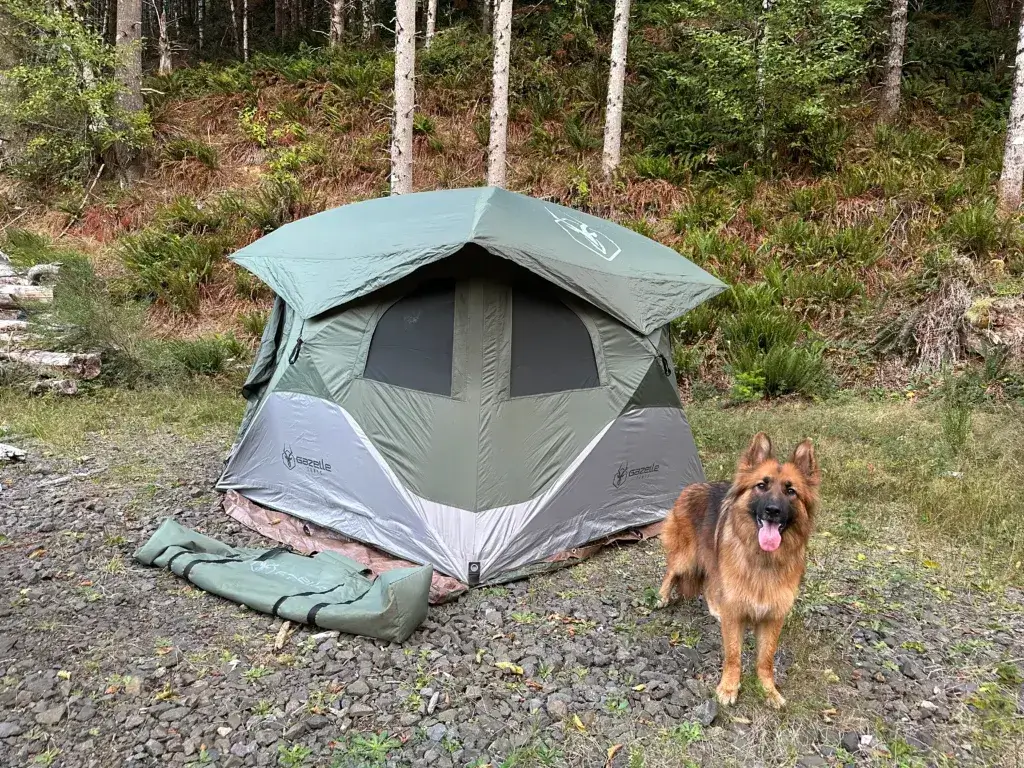
The T4 is a three-season tent that handles fair weather and moderate rain when you stake and guy it properly. It struggles in strong gusts because of its tall, flat-sided shape. I learned that second part the hard way.
What We Learned When a Tent Wall Caved In
One evening, the wind picked up while we were sleeping inside, and one of the T4’s walls caved inward. It wasn’t a collapse of the whole tent, but the wall folded in hard enough to wake us up in the middle of the night. The frame popped back out afterward with no damage.
The cause was our own shortcut. We had staked the corners and skipped the mid-wall loops and guy lines because the forecast looked calm.
A flat eight-foot wall with no tension behind it is a sail. After that night, I staked all eight base loops and ran all four guy lines every time, even on still evenings. The tent never did it again.
How to Use the Rainfly and Windows in Wet Weather
The removable rain fly covers the roof and the upper portion of the walls. Install it before you pop the roof hub: spread it over the collapsed tent, seat the four fly poles into the roof poles at the corners, then push the hub up so everything clicks into place and the poles angle downward.
Then attach the fly’s four hooks to the center hub loops on each wall. Those hooks keep the fly tight and stop it from slapping and pooling water.
In steady rain, zip the fabric window covers closed on the windward side and leave the leeward panels partly open so air keeps moving.
Owners in heavy, sustained rain report water finding its way in, and the T4 isn’t marketed as a storm tent. For weekend trips with passing showers, the fly plus a ground tarp under the footprint handled everything we camped through.
If you hike in the rain and come back soaked, the two doors make it easy to drip on one side and sleep on the other.
Managing Condensation and Warm-Weather Airflow
Airflow is where this tent shines. Six mesh windows plus a mesh roof panel move a lot of air, and with the fly off on a clear night, condensation is rarely an issue.
That much ventilation is also why the T4 is a great summer tent and a chilly one in shoulder season. With the fly on, moisture has fewer places to escape.
Crack the window covers on the sheltered side, keep wet gear in the vestibule area near the door instead of in the middle of the floor, and avoid cooking inside. Our guide on how to prevent condensation in a tent goes deeper into the habits that keep bedding dry.
When to Choose a More Weather-Focused Tent
Pick a different tent if you camp in exposed places with steady wind, snow, or multi-day rain. A low-profile dome sheds wind much better than a cabin shape. A full-coverage fly also protects the walls that the T4 leaves partly exposed.
Cold-weather campers should look at purpose-built options. Our 4 season camping tents roundup covers shelters designed for that job. For hot summer weekends at a campground, the T4 competes well with anything in our best tents for summer camping list.
Materials, Floor Cleanup, and Transport Practicalities
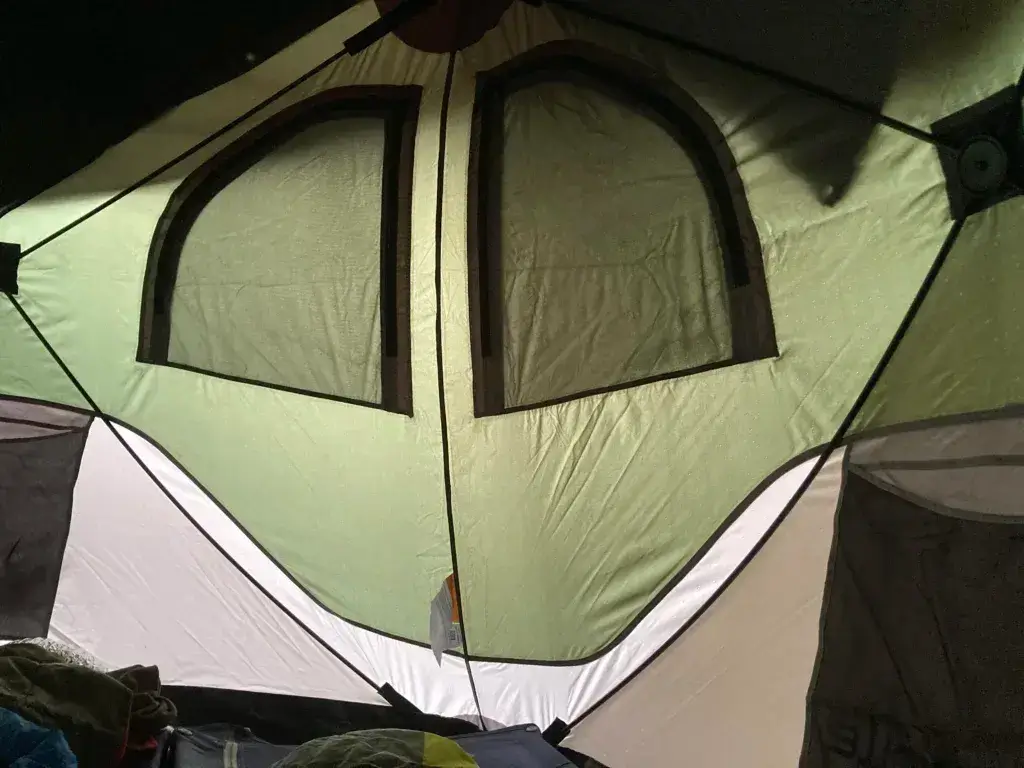
The T4 uses 210D Oxford weave polyester on a fiberglass hub frame, along with YKK zippers. Its standout practical feature is a floor that velcros out completely for cleaning.
It packs into a duffel that fits a car trunk, though it takes up real cargo space.
Oxford Fabric, Fiberglass Hubs, and YKK Zippers
210D Oxford polyester has a heavier, tighter weave than the thin nylon used on lightweight tents. It resists scuffs and holds a waterproof coating well, which helps explain the tent’s weight.
The fabric also carries a UV50+ rating. That’s useful in the desert sun, where cheap tents can turn brittle.
The frame uses fiberglass and stays permanently attached at the hubs. Fiberglass weighs more than aluminum and can crack if you force it, so setup order matters. Don’t pop the roof before seating the fly poles, and don’t yank a wall that’s already under tension.
YKK zippers run the doors and windows. After a few seasons of frequent use, ours never separated or jammed. That’s more than I can say for the no-name zippers on budget tents I’ve owned.
Is the Removable Floor Worth Having?
Yes, and it’s the underrated feature of this tent. The floor attaches with Velcro and pulls out completely, so you can shake it clean, hose it down, or drop it in a tub.
With two shedding German Shepherds, that mattered more than any spec on the box. Dirt, hair, and pine needles come out in a minute.
Removing the floor also turns the T4 into a screened shelter that you can pitch over a picnic table or patch of gravel. That’s handy in buggy campgrounds.
Packed Size, Weight, and Vehicle Storage
The T4 weighs about 34 pounds and packs into a duffel roughly the size of a large golf bag. It fits through a car trunk and across a back seat. Campers with four-door sedans have loaded it without folding the seats down.
Measure before you buy. In an SUV or truck bed, it stacks fine. In a packed hatchback with coolers and chairs, it becomes the item everything else has to work around.
Our how to pack light for camping tips can help if cargo space is tight.
Why This Is Not a Backpacking Tent
At 34 pounds in a bulky duffel, the T4 belongs in a vehicle. Carrying it half a mile to a walk-in site is unpleasant, and taking it on a trail is a non-starter.
The T4 is made for car camping and overlanding, where the tent goes from tailgate to ground in a few steps. Judge it on that job, and it does well. Judge it on trail weight, though, and it loses to tents that cost a third as much.
How the Standard T4 Compares With Other Gazelle Models
The standard T4 is the budget-friendly entry point in Gazelle’s four-person lineup. The other models add size, weather protection, or a second room at higher prices.
I have only owned the standard T4. The notes below come from published manufacturer specifications and feature listings, not from time in the field with those models.
| Standard T4 | T4 Overland EXP | T4 Plus | T4 Tandem | |
|---|---|---|---|---|
| Floor space | 61 sq ft | 61 sq ft | 110 sq ft | Two connected rooms |
| Peak height | 78 in | 78 in | 78 in | 78 in |
| Season rating | 3-season | 4-season | 3-season | 3-season |
| Setup time | ~90 seconds | ~90 seconds | ~90 seconds | ~90 seconds |
| Best for | Budget car camping | Overlanding, cold weather | Families needing a screen room | Two groups or gear separation |
Standard T4 vs. T4 Overland EXP
The Overland EXP is Gazelle’s rugged version, marketed as a four-season shelter with ripstop fabric, TriTech mesh, and a higher waterproof rating. It keeps the same 94-by-94-inch footprint, 78-inch peak, and pop-up hub deployment.
Buy the Overland EXP if you camp in cold or wet conditions and want a ground-based alternative to a rooftop tent. The standard T4 offers better value for summer and shoulder-season weekends.
Standard T4 vs. T4 Plus
The T4 Plus adds a screen room to the enclosed sleeping area, bringing total livable space to about 110 square feet while keeping the roughly 90-second setup. It carries a 2000mm waterproof rating and costs around $600.
That extra room works as a bug-free lounge, a dog area, or a place to stash muddy boots. It also packs bigger and heavier, so check your cargo space before choosing it over the standard model.
Standard T4 vs. T4 Tandem
The Tandem connects two hub sections, giving you separate spaces under one shelter. Families who want kids in one room and adults in the other, or campers who want a dedicated gear room, are the target buyers.
It sets up in the same pop-up fashion. The trade-off is the same as with the Plus: more tent means more weight and more space in the vehicle.
When a Larger Cabin or Dome Tent Makes More Sense
Step outside the Gazelle line if you need more than four sleepers or better wind performance. A large cabin tent like The North Face Wawona 6 gives six people room with a proper vestibule. A low dome tent handles exposed sites better than any hub tent’s boxy profile.
A rooftop tent solves the ground-condition problem entirely, though it costs much more and permanently affects fuel economy. For a screened gathering space next to whatever you sleep in, the Gazelle G6 pop-up gazebo screen tent uses the same hub system in a canopy format.
Who the Standard T4 Fits Best and What Beginners Should Consider
The standard T4 suits vehicle-based campers who value speed and standing room over weight. Beginners should confirm their cargo space and typical weather before buying.
Below are the questions I get asked most about this tent.
Who Should Buy the Standard Gazelle T4?
Car campers who arrive after dark, weekend families who want a walk-in tent, and anyone camping with dogs get the most out of this tent. The removable floor and two D-shaped doors work well for pets. The 78-inch peak also makes rainy mornings tolerable.
Beginners benefit most, since there’s no pole system to learn.
Who Should Choose Another Tent?
Backpackers, thru-hikers, and walk-in site campers should skip it at 34 pounds. Winter campers and anyone who camps on exposed ridgelines should look at a four-season or low-profile dome design.
If you need to sleep more than four adults with gear, a larger cabin tent fits better.
How to Check Your Vehicle Before Buying
Measure your cargo area with everything else loaded: cooler, chairs, water jug, and bins. The T4’s duffel is roughly golf-bag size and doesn’t compress.
It slides through a sedan trunk, though it will sit across your back seat if the trunk is full. Truck and SUV owners rarely have a problem.
Is the Gazelle T4 Worth the Money?
For car campers who camp several times a year, yes. The cost lands above basic dome tents and below premium cabin tents. You’re paying for the hub system, Oxford fabric, and removable floor.
If you camp once a summer at a fair-weather campground, a cheaper dome does the job.
Can One Person Set Up the Gazelle T4?
Yes. Each wall pops open independently, so there’s nothing to hold while you move around the tent.
Solo setup runs three to five minutes, including stakes. The rain fly is the only step where a second person meaningfully speeds things up.
Does the Gazelle T4 Work in Rain and Wind?
It handles moderate rain with the fly properly seated and a ground tarp underneath. It also needs all eight stake loops and four guy lines to stay steady in wind.
Our wall caved in on a gusty night when we had only staked the corners. Skip it for sustained storms or snow.
Is the Gazelle T4 Suitable for Camping With Dogs?
It’s one of the better options for dog owners. The velcro-in floor pulls out for cleaning, two doors keep traffic flowing, and 61 square feet holds two large dog beds alongside two cots.
Our guide to the best dog friendly tents compares it against other picks.
A Fast Basecamp Tent With Real Trade-Offs
The standard Gazelle T4 earns its place for car camping and overlanding because I can pitch it in about two minutes. Once it’s up, I get 61 square feet of standing-height room. The fast hub setup, removable floor, and strong ventilation kept us reaching for it before we moved into a truck camper.
The trade-offs are honest ones. It weighs about 34 pounds and packs into a bulky duffel, so I keep it with the vehicle.
Its tall, flat walls need all eight stakes and all four guy lines when the wind picks up. We learned that lesson the hard way when one wall caved in. It handles passing rain, but I wouldn’t trust it in a storm.
If you camp within a few steps of a tailgate, stick to three-season weather, and need room for dogs or kids to move around, I’d buy the standard T4 over the pricier Gazelle variants. Measure your cargo space first, buy longer stakes for sandy ground, and tension every line on the first night out.